When IT organizations struggle, the instinct is often to focus on execution. Projects run late, costs increase, security concerns emerge, and innovation slows. Leaders respond by introducing new tools, restructuring teams, or adopting new delivery frameworks in the hope that improved processes will solve the problem.
However, high-performing IT organizations are rarely repaired from the middle. They are designed deliberately from the outside in.
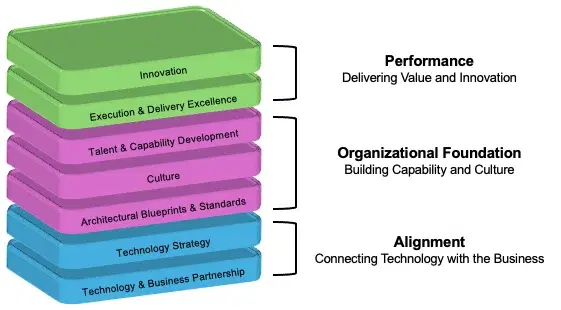
Exceptional IT leadership is not simply about managing technology initiatives. It is about architecting an organization capable of delivering sustained business value. Organizations that consistently perform well tend to evolve through a series of reinforcing layers, each building upon the one before it.
Alignment
1. Technology & Business Partnership: Defining the Why
Technology exists to support the ambitions of the enterprise. High-impact IT organizations begin with strong partnerships across the business. Leaders engage stakeholders to understand what success means for the organization and where technology can create meaningful advantage.
Important questions at this stage include:
- What outcomes define success for the business?
- Where must the organization differentiate in the market?
- What risks threaten growth or operational stability?
- What capabilities must technology enable?
Without genuine partnership, IT becomes reactive, responding to requests rather than shaping outcomes. Stakeholder alignment ensures technology investments remain grounded in business priorities and long-term goals.
Understanding the "why" is the first step, but it must be followed by deliberate choices.
2. Technology Strategy: Making the Critical Choices
Strategy is the act of disciplined decision-making. It defines where the organization will invest, what capabilities must be developed, and which initiatives will be prioritized. Just as importantly, strategy clarifies what the organization will choose not to pursue.
Technology strategy should not be viewed as a list of projects. Instead, it represents a coherent set of choices that align technology investments with business ambitions.
When strategy lacks clarity, execution often becomes fragmented. Teams move forward, but in different directions.
Clear strategy creates focus and provides the direction that guides architectural design, capability development, and delivery priorities.
If stakeholder partnership defines the why, strategy defines the how.
Organizational Foundation
3. Architectural Blueprints & Standards: Designing for Stability and Scale
Before organizations expand teams or accelerate delivery, they must establish a clear structural foundation. High-performing IT organizations define architectural blueprints and standards that guide how technology systems are designed, integrated, and secured. These blueprints establish clarity around:
- Enterprise architecture principles
- Platform and infrastructure standards
- Security-by-design practices
- Data governance and information architecture
- Integration patterns across systems
These standards help ensure consistency across the technology landscape and reduce unnecessary complexity.
Importantly, standards do not limit innovation. When thoughtfully designed, they create a stable foundation that allows teams to move faster with confidence. By defining how systems should be built and integrated, organizations reduce risk and enable scalable growth.
4. Culture: Shaping How the Organization Operates
Culture determines how strategy and architecture are interpreted by the people responsible for delivering technology solutions. A strong culture promotes behaviors that support long-term success, including:
- Accountability and ownership
- Collaboration across teams and disciplines
- Continuous learning and professional development
- Openness to experimentation and improvement
Culture cannot simply be declared. It emerges through leadership behavior, organizational incentives, and the way teams are structured.
In effective IT organizations, culture reinforces strategic priorities and encourages the behaviors necessary to deliver on them.
5. Talent & Capability Development: Building the Capacity to Deliver
Once architectural direction and cultural expectations are established, organizations can deliberately develop the capabilities required to support them.
Talent development ensures that teams possess the technical depth and leadership capacity needed to execute the strategy. This includes expertise in areas such as architecture, cloud platforms, cybersecurity, data engineering, and product management.
Effective organizations invest in capability development through:
- Structured training programs
- Technical certification pathways
- Mentorship and coaching
- Hands-on experimentation environments
- Leadership development and succession planning
These investments require sustained budget commitment. Capability development should not be treated as discretionary spending. If strategy defines the destination, investing in people builds the capacity required to reach it.
Talent development is not simply about increasing headcount. It is about increasing capability density aligned with strategic priorities.
Performance
6. Execution & Delivery Excellence: Turning Direction into Results
Execution is where leadership becomes visible. Delivery excellence translates strategy and architectural design into measurable outcomes through disciplined practices such as:
- Agile development and product management
- DevSecOps automation and continuous delivery
- Operational monitoring and reliability engineering
- Clear performance metrics and accountability
Execution excellence does not arise from process improvements alone. It reflects the combined strength of stakeholder alignment, strategic clarity, architectural discipline, organizational culture, and strong talent.
Organizations that attempt to fix delivery without addressing these underlying layers often encounter the same challenges repeatedly.
7. Innovation: Sustaining Competitive Advantage
Innovation is frequently framed as a separate initiative, such as an innovation lab, a transformation program, or a series of experimental projects.
In mature IT organizations, innovation is not forced. It emerges naturally when the underlying foundations are strong.
When strategy is clear, architecture is stable, culture supports experimentation, talent is capable, and execution is reliable, teams gain the freedom to explore new technologies and ideas.
Innovation then becomes a continuous capability that enables the organization to maintain and extend its competitive advantage.
Conclusion
IT leadership is not only about managing systems or delivering projects. It is about designing organizations capable of sustained performance.
This model highlights three interconnected layers:
Alignment
- Technology & Business Partnership
- Technology Strategy
Foundation
- Architectural Blueprints & Standards
- Culture
- Talent & Capability Development
Performance
- Execution
- Innovation
Each layer builds upon the one before it. When leaders strengthen all three layers, technology organizations move beyond operational support and become drivers of strategic value.
While this model is useful when designing a new IT organization, its value is equally significant for improving existing teams. Many organizations attempt to resolve issues at the point where they are most visible, often within execution and delivery. However, challenges at higher layers are frequently symptoms of weaknesses in the layers below. For example, improving execution and delivery excellence can be difficult when architectural blueprints and standards are unclear or inconsistent.
Effective leaders therefore diagnose issues by looking down the stack. Rather than addressing symptoms in isolation, they examine whether foundational elements such as strategy, architecture, culture, or capability development require attention. In many cases, sustainable improvement comes not from optimizing the visible problem, but from strengthening the layers that support it.
High-impact IT organizations are not accidental. They are intentionally designed, and deliberately improved.
For organizations looking to apply this approach in practice, this model can also be used as a structured diagnostic tool. We offer an IT Leadership Architecture Assessment to evaluate current capabilities across each layer and identify the foundational changes required to improve performance.